

.PSD File Extension
Adobe Photoshop Document
| Developer | Adobe |
| Popularity |
4.2 | 721 Votes |
What is a PSD file?
A PSD file is the native image format used by Adobe Photoshop, a professional image-editing program used for enhancing digital photos and creating web graphics. PSD files may include image layers, adjustment layers, annotations, file information, keywords, and other Photoshop-specific elements. They are commonly created and shared among graphics professionals.
More Information
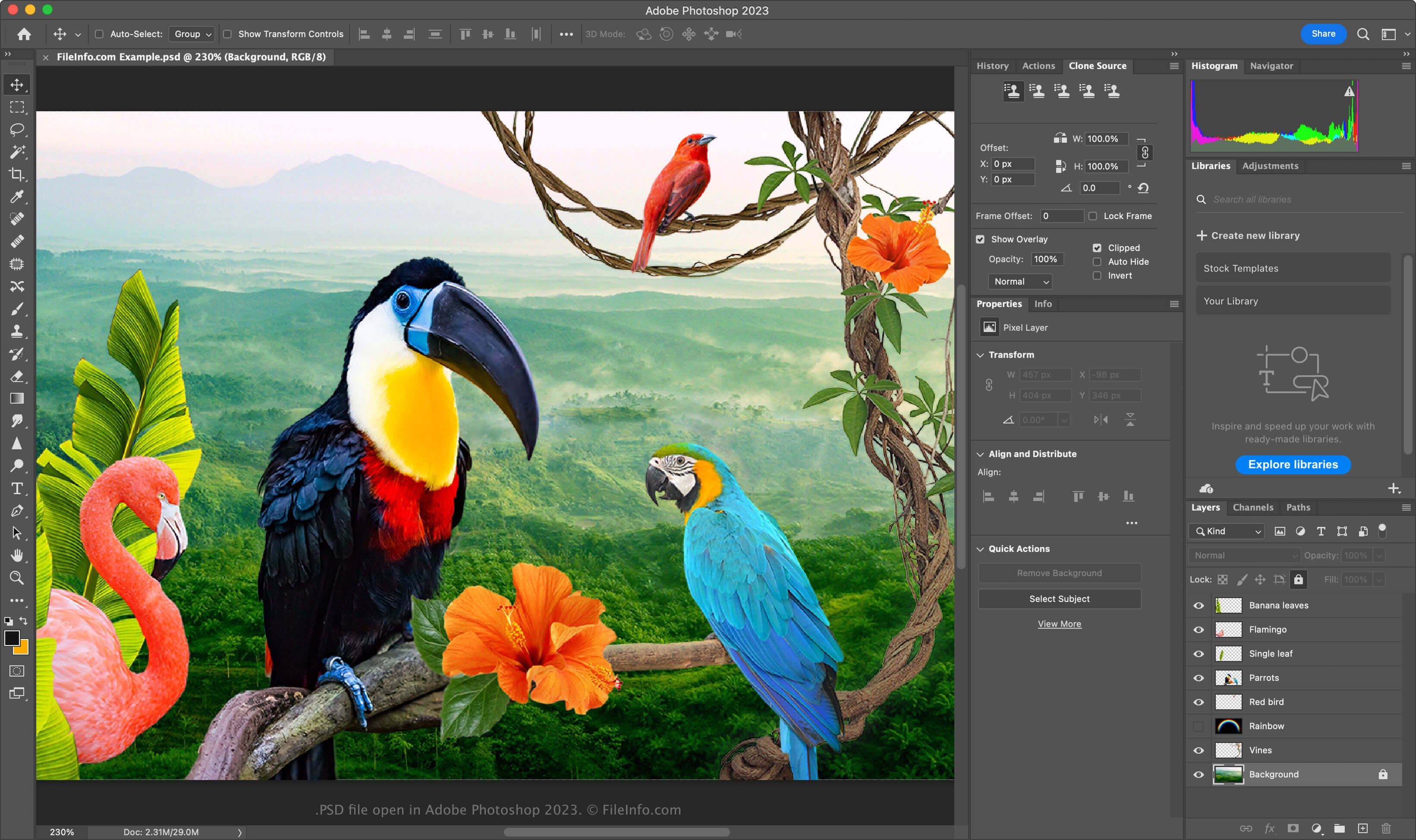
The PSD format is a fully editable, uncompressed format, ideal for editing raster images. You can modify individual elements within a PSD file, such as images, shapes, text, and effects. New versions of Photoshop (2024 and later) allow you to create and insert AI-generated graphics.
PSD files support RGB, CMYK, grayscale, monochrome, duotone, indexed color, Lab color, and multichannel color modes. You can change the color mode by selecting the in Photoshop.
The data structure of a PSD file
The Photoshop file format is comprised of five sections:
- File Header - Stores image properties like dimensions, bit depth, color mode, and channel count
- Color Mode Data – Includes additional data if the file uses indexed or duotone colors
- Image Resources – Contains non-image elements such as guides, text styles, or paths
- Layer and Mask Information – Stores data about layers, masks, blending modes, and effects
- Image Data – Contains the actual image data (pixel data) and the compression method used to reduce the overall file size (e.g., raw, RLE, ZIP)
NOTE: Photoshop supports PSD files up to 30,000 x 30,000 pixels or 2 GB in size. Images larger than these limits must be saved in the .PSB (Photoshop Big) Large Document format.
How to open a PSD file
You can open PSD files with Adobe Photoshop in Windows and macOS. To open a PSD file in Photoshop, select .
While PSD files are saved in a proprietary format, you can also open them with other multi-platform applications, such as Adobe Illustrator, Corel Painter, GIMP, and Photopea (in a web browser).
In Windows, you can open PSD files with the built-in Microsoft Photos app. In macOS, you can view them with Apple Preview, which is bundled with the operating system.
How to convert a PSD file
Several applications, including Adobe Photoshop, Corel PaintShop Pro, and Apple Preview, can convert PSD files to other formats.
For example, Adobe Photoshop can export PSD files to: