

.PROPERTIES File Extension
Minecraft Properties File
| Developer | Mojang Specifications |
| Popularity |
4.4 | 801 Votes |
What is a PROPERTIES file?
A PROPERTIES file is a settings file used by Minecraft, a sandbox block construction game. It stores configuration information for the game in the Java Properties key-value pair plain text format, which also has applications outside of Minecraft. In Minecraft, gamers may use PROPERTIES files when configuring a multiplayer server or a game mod.
More Information
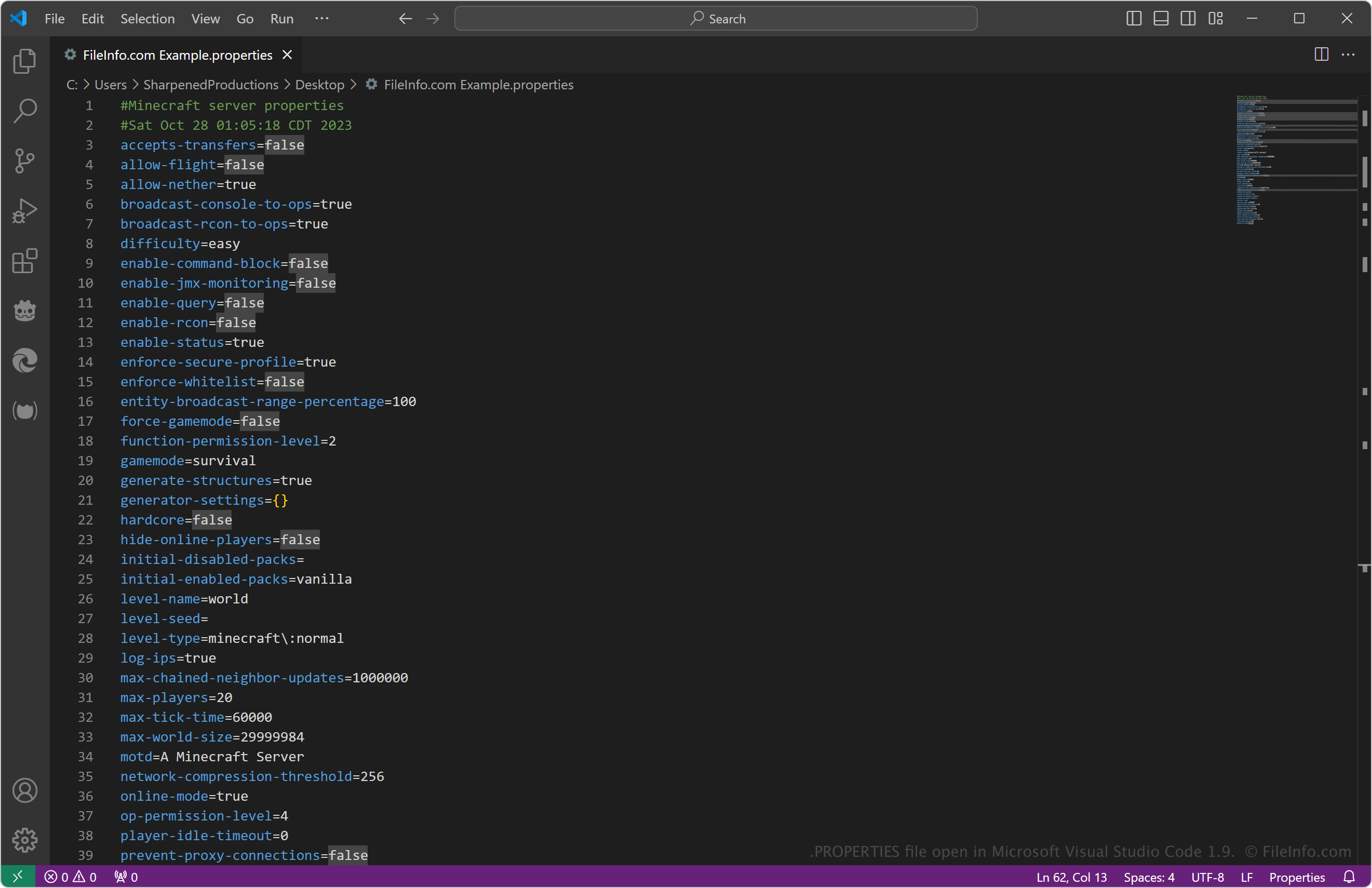
The most common Minecraft properties file is server.properties, which stores configuration data for a multiplayer server. It saves information such as the level name, monster spawning settings, the maximum allowed players, and the server port and IP address.
You will likely only encounter a PROPERTIES file in the context of Minecraft if you are looking to modify the configuration of a multiplayer server. Specifically, you can find the server.properties file in the same directory as the server.jar file you executed to run the server (the server generates it upon its first startup).
Common .PROPERTIES Filenames
server.properties - Common file that stores all the settings for a Minecraft multiplayer server.
How to open a PROPERTIES file
You can open PROPERTIES files with any text editor, such as Microsoft Notepad (Windows), Apple TextEdit (macOS), and gedit (Linux). You can also open the files with source code editors, including Microsoft Visual Studio Code (multiplatform), which provides helpful source code viewing and editing features.
Remember that incorrectly modifying the text, especially the "key" text (before the equal sign), in the PROPERTIES file may corrupt the file. Also, if you edit the server.properties file, you must restart the server or execute the /reload command for the server to apply the changes.
Programs that open or reference PROPERTIES files
Java Properties File
| Developer | Sun Microsystems |
| Popularity |
4.0 | 98 Votes |
A PROPERTIES file may also be a text-based configuration file used by Java applications to store data as simple key–value pairs. Java programs load these files using the java.util.Properties API (or the closely related ResourceBundle API), allowing applications to read settings such as preferences, file paths, feature flags, or user-facing text. Each line typically follows the format key = value, making the files easy to edit and maintain.
More Information
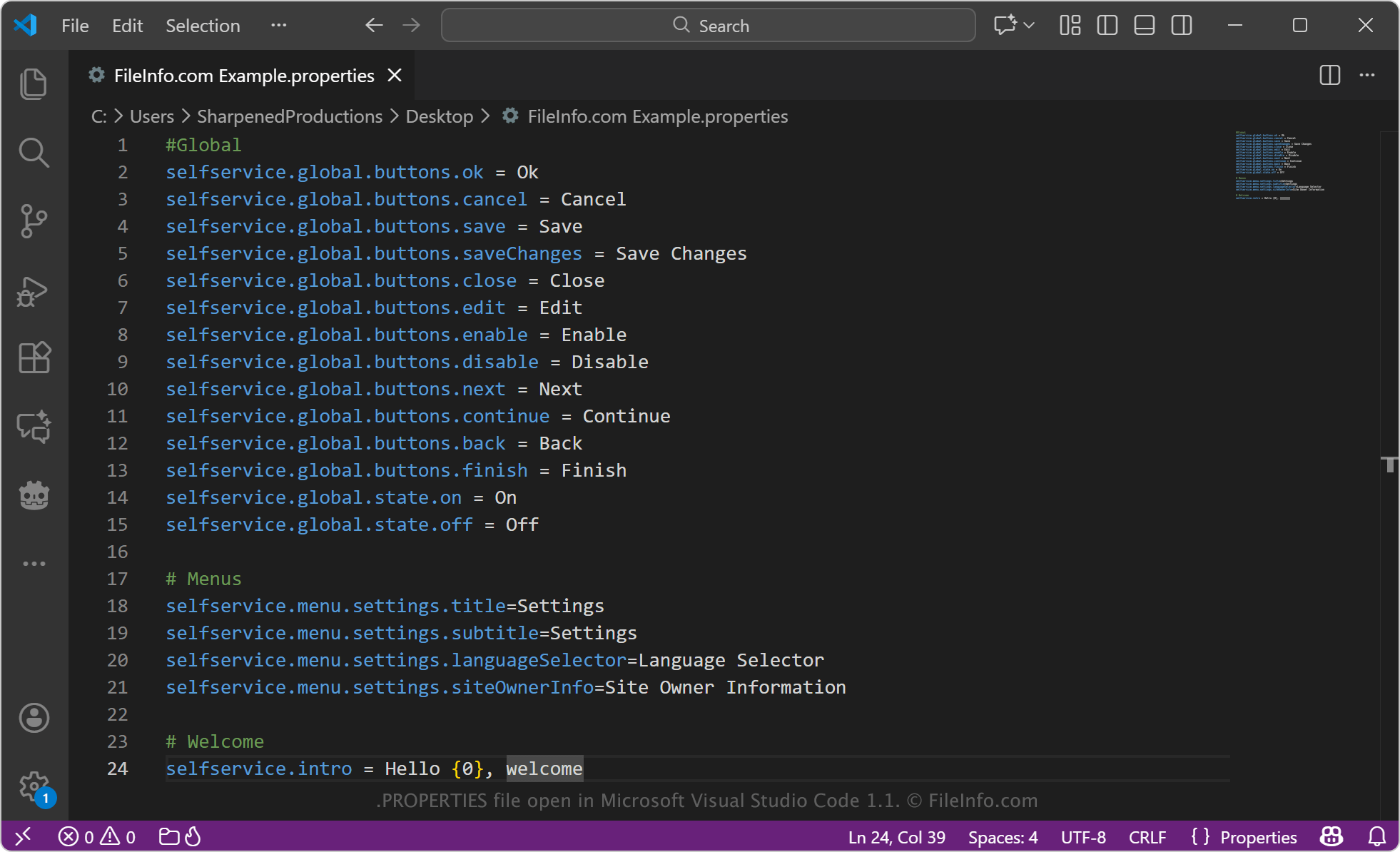
In addition to configuration data, PROPERTIES files are commonly used for localization and translation in Java applications. In this role, each file represents a specific language or locale, such as Bundle.properties (default language) and Bundle_sl.properties (Slovenian). The keys remain the same across languages, while the values contain translated text shown in the app's interface. Many PROPERTIES files use Unicode escape sequences (for example, \u0161) to represent non-ASCII characters, a long-standing convention that ensures compatibility across Java versions and tools.
Unlike some configuration systems, Java does not automatically persist PROPERTIES files to a fixed directory or convert them into nested folders. Where and how a PROPERTIES file is stored depends entirely on the application, often alongside the program files, inside a .JAR or ZIP-based installer, or within a project's resources directory. Developers access and manage these files directly through the java.util.Properties or ResourceBundle APIs, giving full control over loading, saving, and updating property values.
How to open a PROPERTIES file
You can open PROPERTIES files with source code editors, such as Microsoft Visual Studio Code, Sublime Text, or Notepad++. Any plain text editor will open PROPERTIES files, as well, including Microsoft Notepad, Apple TextEdit, and gedit.
When editing a PROPERTIES file, it is important to preserve the key = value structure and avoid removing escape sequences like \uXXXX, which represent Unicode characters. Also, while editors can view and edit PROPERTIES files, they are typically intended to be loaded and managed by Java applications rather than opened directly by end users.